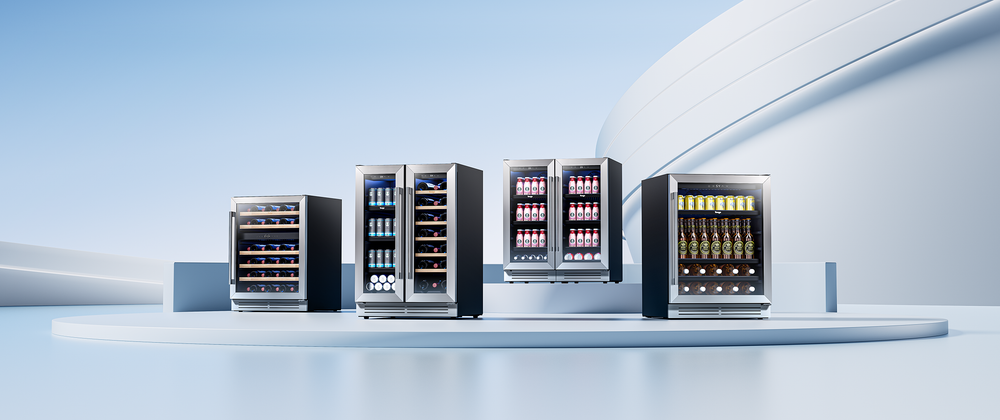

Built-In vs. Freestanding Beverage Fridges: What’s the Real Difference?
Key Takeaways
- Built-in beverage fridges are designed to operate inside a properly sized cabinet opening, and many models vent from the front.
- Freestanding beverage fridges generally need more open space for airflow. They should not be enclosed simply because their dimensions fit.
- Nominal size, actual appliance dimensions, and required cabinet cutout dimensions are three different measurements.
- Built-in models are often a good fit for kitchen islands and permanent home bars. Freestanding models offer more flexibility in basements, apartments, offices, and entertainment rooms.
- Garages and outdoor spaces require additional checks. A freestanding design does not automatically mean the fridge can handle extreme temperatures or outdoor exposure.
When shopping for a beverage fridge, most people start with measurements. If they have a 24-inch opening under the counter, they look for a 24-inch model. If there’s unused space along a wall, they choose a fridge that appears to fit.
Measurements matter, but they answer only one question: Will the appliance physically fit in the space? They don’t tell you whether the fridge is designed to operate properly in that location over time.
The real difference between a built-in and a freestanding beverage fridge isn’t simply where the unit sits or how it looks. It comes down to how the appliance releases heat and whether it’s designed to operate inside an enclosed cabinet opening.
Some beverage fridges are approved for both built-in and freestanding installation, so appearance alone isn’t enough. Always check the installation type listed on the product page and in the manufacturer’s installation manual.

The Core Difference Is Ventilation
A beverage fridge pulls heat from inside the cabinet and releases it into the surrounding room. Wherever it’s installed, that heat needs somewhere to go.
The main difference between built-in and freestanding models is how each appliance is designed to manage that airflow.
Built-In Beverage Fridges
A built-in beverage fridge, sometimes called an undercounter beverage fridge, is designed to operate inside a cabinet opening.
Many undercounter models place the main ventilation area at the front or along the lower front section of the appliance. This allows the fridge to exchange air even when its sides sit close to the surrounding cabinetry.
This front-venting setup makes many built-in beverage fridges suitable for kitchen islands, wet bars, and other fixed cabinet installations.
However, front ventilation doesn’t mean you can skip careful planning. You still need to account for:
- The manufacturer’s required cutout dimensions
- Electrical connections and power-cord placement
- Leveling feet
- Door swing
- Handle projection
- An unobstructed front grille
A cabinet toe kick, decorative panel, rug, or stored item should never block the ventilation area.
Freestanding Beverage Fridges
A freestanding beverage fridge is designed primarily for use in an open area.
Airflow requirements vary by model, but freestanding-only units often need additional clearance around the back, sides, or top. If the appliance is enclosed too tightly, heat may build up around it instead of escaping into the room.
This can make the fridge run longer or work harder to maintain its set temperature. Cooling performance, exterior cabinet temperature, and sound levels may also be affected.
Don’t place a freestanding-only fridge inside cabinetry simply because its width and height fit. The model must be specifically approved for built-in installation.
Dual-Installation Models
A dual-installation beverage fridge can be installed inside a compliant cabinet opening or used as a standalone appliance when the manufacturer specifically approves both options.
This flexibility can be useful if you haven’t finalized your renovation plans or may want to move the fridge to another room later.
However, dual-installation capability doesn’t remove the normal installation requirements. Built-in use still requires the correct cutout and ventilation conditions. Freestanding use requires a level surface, a suitable power supply, and an appropriate surrounding environment.
| Comparison | Built-In Beverage Fridge | Freestanding Beverage Fridge |
|---|---|---|
| Typical placement | Kitchen island, permanent home bar, or undercounter cabinetry | Basement, office, entertainment room, or open wall space |
| Ventilation | Designed for cabinet installation; many models vent from the front | Usually requires more open airflow around the appliance |
| Installation planning | Requires cutout, door-swing, power, and ventilation checks | Requires proper clearance, a level surface, and a suitable environment |
| Flexibility | Usually stays in a fixed location | Easier to move or reposition |
| Appearance | Can create a more continuous cabinet layout | Remains more visually separate from nearby furniture or cabinets |
These are general guidelines. Always check the specific model’s installation requirements before making a decision.
Why a Fridge Can Fit and Still Be Installed Incorrectly
A beverage fridge labeled as a 24-inch model won’t necessarily fit every 24-inch cabinet opening.
“24-inch” is usually a product category, not a promise that the appliance measures exactly 24.00 inches wide. Actual width, height, and depth vary by model. Cabinet openings can also differ because of panel thickness, flooring, countertop construction, and installation tolerances.
Before buying, make sure you understand the difference between appliance dimensions and required cutout dimensions.

Appliance Dimensions
Appliance dimensions describe the physical size of the unit. Check the specification sheet for:
- Whether the listed depth includes the door
- Whether the handle is included in the total depth
- Whether the listed height includes adjustable feet
- How much space is needed for the door to open fully
These details matter because the fridge may fit inside the opening but still extend farther into the room than expected.
Cutout Dimensions
Cutout dimensions describe the cabinet opening required for installation.
For a built-in beverage fridge, these measurements are usually more useful than the nominal size listed in the product name. Measure the opening’s width, height, and depth. You should also check that the opening is level and square.
Even when the basic measurements match, several other issues can prevent the fridge from working well in the space.
The Door Cannot Open Fully
A beverage fridge placed beside a wall, cabinet end panel, drawer, or another appliance may not have enough room for the door to open fully.
The door needs to open far enough for the interior shelves to slide out properly. Being able to grab a can near the front isn’t the same as having full access to the storage inside.
The Handle Projects Into the Walkway
The handle may not affect whether the appliance body fits into the cutout, but it can extend into a walkway or collide with nearby cabinet doors and drawers.
This is especially important in narrow kitchens, small apartments, and bar areas near dining chairs.
The Outlet Adds Unplanned Depth
A wall outlet and plug directly behind the fridge can prevent the appliance from sliding completely into place.
The power cord shouldn’t be compressed between the appliance and the wall. The plug should also remain accessible for servicing or disconnection.
The Ventilation Grille Is Blocked
Some cabinet toe kicks run continuously across the bottom of an installation. If the panel covers the beverage fridge’s front grille, the appliance may fit physically while the ventilation path remains blocked.
Before ordering, review the appliance dimensions, cutout diagram, door swing, and vent location together. Width alone isn’t enough.
Which Beverage Fridge Is Better for Your Space?
Neither installation type is automatically better than the other.
The right choice depends on the room, how the space is currently set up, and whether you may want to move the appliance later. Comparing beverage fridges by location can help narrow your options, but you’ll still need to check each model against the actual installation conditions.
Kitchen Island or Fixed Cabinet Opening
Best fit: Built-in or dual-installation beverage fridge
A kitchen island or permanent undercounter opening is one of the clearest places to use a built-in beverage fridge.
The goal is often more than simply adding space for cold drinks. Many households want to move soda, sparkling water, beer, and other beverages out of the main refrigerator without adding another appliance elsewhere in the room.
A built-in fridge can use the existing cabinet footprint while helping the kitchen maintain a more continuous layout.
Before buying, confirm that:
- The model is approved for built-in installation
- The cabinet cutout matches the required dimensions
- The front grille will remain unobstructed
- The door won’t hit a drawer, cabinet door, wall, or end panel
- The shelves can slide out when the door is open
- The outlet and plug won’t add unexpected installation depth
Don’t push a freestanding-only fridge into an island opening simply because its width looks right. Kitchen cabinetry usually surrounds the sides and back more closely than an open-room installation.
Ventilation problems may not appear immediately. Over time, you may notice longer cooling cycles, slower temperature recovery, or more heat around the cabinet.
Home Bar, Sideboard, or Breakfast Area
Best fit: Depends on whether the cabinetry already exists
Home bars come in all shapes. Some are planned as part of a renovation, while others grow gradually as a household’s storage and entertaining needs change.
If the bar already has a dedicated appliance opening, a built-in beverage fridge will usually create the cleanest layout. It can sit naturally within the surrounding cabinetry without using additional floor space.
In many existing homes, however, the setup starts with a sideboard, serving cabinet, or small drink station. Later, the family may realize that the main refrigerator no longer has enough room for everyday beverages.
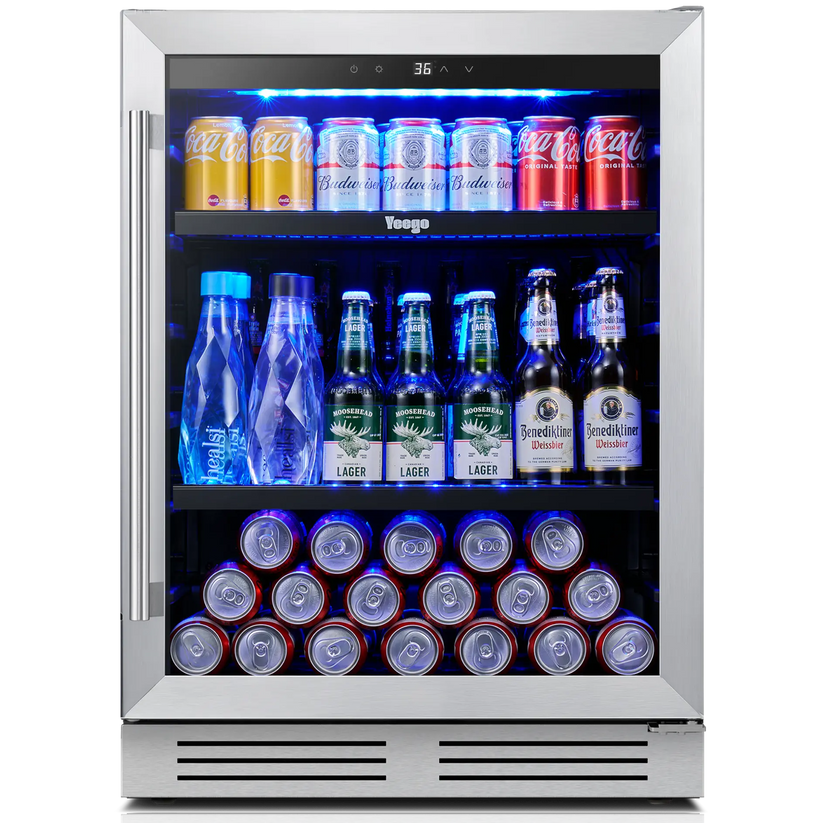
Yeego 24" Beverage Cooler
When there’s no existing cutout and no plan to rebuild the cabinetry, a freestanding or dual-installation fridge is usually the more practical choice.
Think about everyday use as well:
- Can family members and guests reach the fridge easily?
- Will the open door block the walkway?
- Is there a convenient outlet nearby?
- Will the fridge sit too close to the dining table?
- Is there enough room to restock drinks and adjust the shelves?
Placing a freestanding-only fridge tightly between two cabinets doesn’t turn it into a built-in appliance. You still need to follow the airflow requirements for that model.

Basement, Game Room, or Home Theater
Best fit: Freestanding or dual-installation beverage fridge
Basements and entertainment rooms often need convenient beverage storage without requiring a complete second kitchen.
A family may already have a TV, sectional sofa, gaming system, and snack area but still need to go upstairs whenever someone wants a drink. In this setting, easy access may matter more than creating a fully integrated cabinet wall.
For households that use the room for sports viewing or casual gatherings, these [game-day drink station ideas] can also help organize beverage access and restocking without sending guests back to the kitchen.
A freestanding beverage fridge can sit beside an entertainment console, near a snack counter, or close to the stairs without requiring custom cabinetry.
Flexibility is another advantage. The room may later be rearranged for a larger TV, different seating, or a permanent bar. A freestanding appliance can move as the space changes.
Placement still requires some planning:
- Avoid enclosed corners with poor airflow
- Keep the open door out of the main walking path
- Place the fridge on a level surface to help reduce vibration
- Avoid placing it directly beside the main seating area
- Check damp basements for suitable ventilation and moisture conditions
For a basement that may eventually include permanent bar cabinetry, a dual-installation model can provide a practical transition. You can use it as a freestanding fridge now and install it in a compliant cabinet opening later.
Small Kitchen, Apartment, or Rental Home
Best fit: Freestanding, narrow, or dual-installation model
In a small space, it’s easy to focus so much on fitting the fridge into a narrow gap that you overlook how the appliance will work after it’s installed.
A slim fridge may fit between two pieces of furniture but still block the walkway whenever the door opens.

Apartments and rental homes also tend to limit permanent cabinet changes. A narrow beverage fridge for small spaces, especially one approved for both built-in and freestanding use, can often be added without removing existing cabinetry. It can also move with you later.
Possible locations include:
- An open wall near the kitchen
- A corner of the dining area
- The end of a counter run
- A small beverage station outside the main kitchen work zone
Measure more than the available width. Also check:
- Door-open depth
- Handle projection
- Clearance near a wall or corner
- Required airflow around the appliance
- Distance from dining chairs
- Safe access to an outlet
In a small kitchen, “it fits here” and “it works here every day” are two different standards.
Home Office, Studio, or Small Business
Best fit: Usually freestanding
In a home office, salon, photography studio, waiting area, or small business, a beverage fridge is often added after the room is already set up.
The goal may be to provide bottled water, canned drinks, or cold brew for employees, clients, or visitors without remodeling the space.
A freestanding model is often the simplest option. It can sit near a reception counter, break area, or meeting space and be moved later if the layout changes.
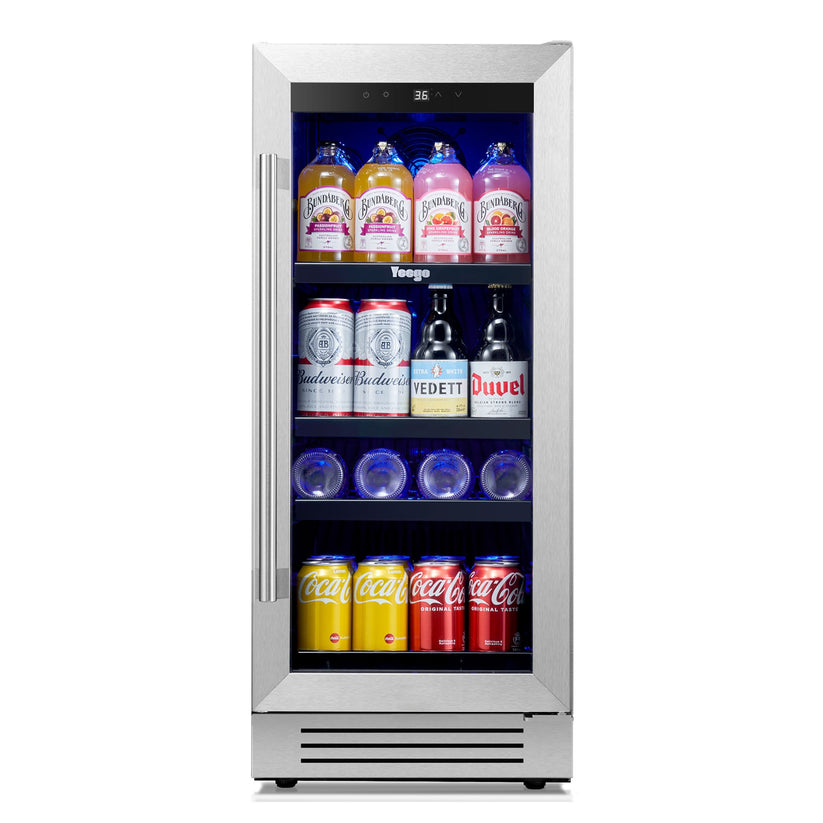
15" Beverage Cooler 100 Cans
Compact yet spacious beverage cooler with 100-can capacity, precise temperature control, and flexible placement for home, bar, or office spaces.
Capacity isn’t the only consideration. Think about how the location will affect daily use:
- The door shouldn’t open into the main path of foot traffic
- The fridge shouldn’t sit directly beside a quiet meeting area
- Keep a glass-door model away from strong direct sunlight
- Leave enough room for staff to restock drinks and adjust the shelves
- Don’t allow boxes or cleaning supplies to block the ventilation area
If the office already has a finished kitchenette with an undercounter opening, a built-in model may be a better fit. The installation environment still matters more than whether the fridge is being used at home or in a workplace.
Outdoor Kitchen or Covered Patio
Best fit: An appliance specifically rated for outdoor use
Built-in or freestanding status alone won’t tell you if a fridge is outdoor-ready.
An indoor freestanding beverage fridge doesn’t become outdoor-ready simply because it sits under a covered patio. An indoor built-in model also doesn’t become suitable for outdoor use just because it’s placed inside an outdoor cabinet.
Outdoor appliances may need to handle:
- Wider temperature swings
- Humidity
- Moisture exposure
- Sunlight
- Outdoor electrical requirements
- Different cabinet and ventilation conditions
A permanent outdoor kitchen may work best with an outdoor-rated beverage fridge that fits alongside the grill, prep counter, and storage cabinets while supporting the planned installation method.
A flexible patio drink station may use an outdoor-rated freestanding model instead. In either case, the appliance must be specifically approved for the intended environment.
Conclusion
Neither built-in nor freestanding is automatically the better choice.
A built-in beverage fridge can work well in a properly planned cabinet opening and fit naturally into a kitchen or permanent home bar. A freestanding fridge is easier to place, move, and use without remodeling the room.
The biggest mistake isn’t choosing one type instead of the other. It’s making the decision based only on exterior dimensions and product photos.
For a fixed cabinet opening, start with models specifically approved for built-in installation. For a basement, apartment, office, or room that may change over time, a freestanding or dual-installation model may be more practical. Garages and outdoor spaces require additional review because ambient temperature and environmental ratings matter just as much as installation type.
Frequently Asked Questions
1. Can a beverage fridge store milk, leftovers, or other perishable food?
Not every beverage fridge is suitable for storing perishable food. Check whether the manufacturer approves the model for food storage instead of assuming that any cold beverage compartment can replace a standard refrigerator.
If you plan to store milk, leftovers, or other perishables, the appliance should consistently maintain a temperature of 40°F (4°C) or below. An appliance thermometer provides a more reliable reading than judging the temperature by touch.
2. Can a beverage fridge be used as a regular refrigerator for food?
A beverage fridge shouldn’t replace a standard food refrigerator unless the manufacturer permits that use and the appliance can consistently maintain 40°F (4°C) or below.
Some beverage coolers are made primarily for bottled and canned drinks and may operate at warmer temperatures than a standard refrigerator. Don’t store milk, leftovers, meat, eggs, or other perishables based only on how cold the cabinet feels. Use an appliance thermometer to confirm the actual storage temperature.
The FDA recommends keeping refrigerators at 40°F or below for safe food storage.
3. Can wine be stored in a beverage fridge?
A beverage fridge can be used to chill wine for serving if the temperature range and shelf layout are suitable. However, it may not be the best option for long-term wine storage.
Dedicated wine fridges generally operate at warmer temperatures and may include bottle-friendly shelving, reduced light exposure, and single- or dual-zone temperature control. A colder beverage-fridge setting may over-chill the wine, while upright shelves may not accommodate every bottle shape.
For a few bottles that you plan to enjoy soon, a beverage fridge may be enough. For a larger collection or longer storage period, a dedicated wine fridge or combined wine-and-beverage model is usually more appropriate.
4. Can a beverage fridge be unplugged when it won’t be used for several months?
Yes. Before leaving the fridge unused for several months, remove all beverages, unplug the appliance, clean the interior, and dry every surface thoroughly.
Moisture, spills, and trapped air inside an unplugged fridge can contribute to odors or mildew. Unless the manufacturer provides different instructions, leave the door slightly open to allow air to circulate. Clean and dry removable shelves before storing them as well.
Whirlpool’s undercounter-refrigerator vacation guidance also recommends unplugging and cleaning the appliance and leaving the door propped open during an extended shutdown.
5. Why does a beverage fridge hold fewer cans than the advertised capacity?
Advertised capacity is usually based on a specific container size and shelf arrangement. Most households won’t use that exact setup.
Slim cans, standard cans, glass bottles, bottled water, and larger containers all have different shapes and dimensions. Raising or removing a shelf to fit taller bottles can also reduce the number of available storage levels.
Capacity figures are most useful when comparing models under similar test layouts. If you plan to store a mix of cans and bottles, review the shelf dimensions and adjustable layout instead of relying only on the advertised can count.
Beverage-fridge buying guides also recommend considering both the number and variety of containers you plan to store.