
Home Beverage Station Ideas for Easier Family Movie Nights
Key Takeaways
- A movie-night drink station should support how the room is used, not turn it into a second kitchen.
- Choose fridge capacity based on how you actually use the space, how many drink types you keep on hand, and how often you want to restock, not household size alone.
- A fridge that physically fits may still be poorly placed if the open door or people using it block the walkway.
- Organize drinks by how often they're used, while keeping bulk backup stock elsewhere.
- Compact, narrow, and 24-inch beverage fridges serve different needs depending on available space, usage frequency, and distance from the kitchen.
- The best setup keeps the entertainment room usable for longer stretches with fewer trips back to the kitchen.
A family entertainment room can look finished long before it actually feels finished. The TV's mounted, the sofa's in place, the speakers are connected, and maybe you've even added a game console or blackout shades. On paper, the family room, basement entertainment room, or home theater looks complete.
Then movie night starts, and people keep leaving the room.
Someone heads to the kitchen for water. Ten minutes later, somebody wants a soda. Snacks run out, another trip happens, and if the entertainment space is downstairs, every refill means going up and down the stairs.
The problem isn't that the room is missing another piece of equipment. It's that it's set up for watching, but not necessarily for spending two or three uninterrupted hours there.
That's where a home beverage station can make a practical difference. It doesn't need to be a full wet bar, and it certainly doesn't need to turn the living room into a second kitchen. The goal is simple: keep the drinks and basic serving essentials people actually use during movies, games, and sports nights close enough that the entertainment area can run on its own for a while.
A well-planned drink station should make the room easier to use without crowding the space, blocking foot traffic, or creating another area that constantly needs attention.

A Practical Drink Station Shouldn't Become a Second Kitchen
Home beverage stations often go wrong in one of two directions. Some are too minimal: a compact fridge is placed in a corner, but cups, snacks, backup drinks, and empty cans still have nowhere to go. Others become unnecessarily elaborate, with sinks, cabinetry, bottle storage, large countertops, and enough equipment to turn a straightforward convenience upgrade into a renovation project.
A better approach is to define what the space actually needs to do.
The kitchen should remain the home's main zone for food storage, preparation, cleanup, and bulk inventory. As with a well-planned summer drink station, an entertainment-room setup works better when it gives frequently used drinks a dedicated place instead of duplicating the entire kitchen.
Think of it as a service point: a place that keeps the drinks people are most likely to reach for over the next few hours close by, provides somewhere to set a glass or bottle, and lets family members serve themselves without repeatedly walking through the rest of the house.
That boundary matters because it determines whether the drink station makes everyday life easier or simply creates another system to maintain.
A 24-pack of bottled water doesn't need to live permanently in the family room. Keep a reasonable working supply nearby and leave the rest in the pantry or garage. The same applies to glassware. A few frequently used cups may make sense in the entertainment area; relocating an entire kitchen cabinet doesn't.
Food prep, dishwashing, and bulk snack storage can stay where they already work best.
The more useful question isn't, “What else can we add to this station?” It's, “Once the movie starts, which needs are actually worth handling in this room?”

Study How Your Family Actually Drinks Before Choosing a Fridge Size
When people start planning a home beverage station, they often begin with capacity. Is 100 cans enough? Is a 24-inch beverage fridge too large? Would a compact cooler be more practical?
Those numbers don't mean much until they're connected to how the room is actually used.
Two four-person households can have completely different refrigeration needs. One family may watch a movie once a week in a living room that's only steps from the kitchen. Another may use a basement for movies, sports, gaming, and weekend hangouts almost every day. The household size is the same, but the amount of beverage storage that makes sense in each entertainment area can be very different.
More useful factors include how often the room is used, how long people usually stay there, how many beverage types the household keeps on hand, how easy it is to restock, and whether friends or extended family regularly use the space.
It also helps to separate serving capacity from storage capacity.
Serving capacity is the amount of chilled drinks needed for an evening or the next few days. Storage capacity is the total inventory the household wants the appliance to hold over a longer period.
Many families need reliable serving capacity more than they need bulk storage. They don't need every case of water, soda, sparkling water, and juice moved downstairs at once.
That distinction directly affects appliance size.
If the kitchen is right next to the living room and restocking every few days takes almost no effort, a compact beverage cooler may be enough. If the entertainment room is in the basement and every refill involves carrying drinks downstairs, a larger working capacity can meaningfully reduce how often someone has to restock.
Bigger isn't automatically more convenient. The right capacity is the amount that comfortably covers normal use between restocks without turning the room into a warehouse for drinks nobody reaches for.
Choosing based on actual use also helps avoid oversizing the appliance for a relatively light-use room. ENERGY STAR recommends choosing an appropriately sized refrigerator, noting that larger refrigeration appliances generally use more energy.
A Beverage Fridge Can Fit and Still Be in the Wrong Place
When homeowners consider a beverage fridge for the living room or basement, the first measurement is usually simple: width.
There's 24 inches of open wall space, so a 24-inch fridge should fit.
But appliance dimensions are only the first layer of space planning.
A refrigerator also has to open, be loaded, be restocked, and leave enough room for someone to stand in front of it while everyone else continues moving through the room. The more useful measurement is the appliance's operational footprint, not just its cabinet dimensions.

Imagine a beverage fridge placed between the sofa and the basement stairs. The cabinet itself may stay completely out of the way. Once the door is open and someone is standing in front of it looking for a drink, however, the clear walkway can disappear. Add a side table, a game console cabinet, or another person walking by, and the placement starts to feel much less convenient.
That's why the best movie-night beverage fridge location isn't necessarily the spot closest to the sofa.
Low interference matters more than saving a few steps. A fridge positioned along a side wall, beside a console, or near the edge of the family room can often be easier to live with than one pushed directly into the seating area.
A useful test is to walk through the whole motion instead of just measuring the wall once. Open the door. Stand in front of the appliance. Reach for a drink on the lowest shelf. Then imagine someone else trying to walk past at the same time.
If those movements start competing for the same space, the location isn't truly convenient.
The same principle applies to a narrow beverage fridge. A smaller width can solve a difficult space constraint, but narrow doesn't mean you can ignore depth, door swing, or the clearance needed to actually use the appliance.
Installation type matters as well. Built-in and freestanding beverage fridges can have different airflow and placement requirements, so an open wall location and an enclosed cabinet opening shouldn't automatically be treated as interchangeable.
If space is your biggest constraint, the real goal isn't just making the fridge fit. It's making sure the room still works normally once it's installed.
Organize Drinks for Retrieval, Not for a Perfect Photo
Many beverage station photos show rows of identical cans lined up by color and brand, with every shelf looking picture-perfect. It photographs well. It doesn't always reflect how a family actually uses the fridge.
A home beverage fridge should be organized around how people actually grab drinks: who reaches for what, how often they reach for it, and how easy it is to get without moving everything else.
The easiest shelf to access should hold the drinks people use most often, not the packages that look best together. If water and sparkling water are reached for every day, they deserve the most convenient position. Drinks used less frequently can go lower or farther back. Backup stock may not need to be inside the fridge at all.
This creates a simple access hierarchy.
High-frequency drinks get the easiest positions. Medium-frequency drinks occupy secondary areas. Low-frequency and reserve inventory stay out of the prime grab-and-go zone.
The advantage isn't just faster access. It also reduces how often people have to shuffle cans and bottles around just to reach what they want.
Package format matters too.
Standard cans, slim cans, plastic bottles, and glass bottles all have different heights and diameters. If every shelf is set to the same height for visual symmetry, usable capacity can drop quickly. A more practical setup adjusts shelf spacing around the packages the household actually buys instead of trying to force real-world drinks into an idealized “maximum can count.”
That's why advertised capacity should be treated as a starting point rather than the whole answer.
When comparing beverage fridges, shelf adjustability, package compatibility, visibility, and ease of access can matter just as much as the headline number of cans the unit can theoretically hold.
For households with children or teenagers, clear organization can help too. Water, juice, soda, and other everyday drinks can be kept in easy-to-recognize areas. If the household also stores beverages intended only for adults, those should be managed separately by adults rather than mixed into the same grab-and-go section.
Convenience works best when the storage logic is obvious to everyone using the room.
A Good Beverage Station Is Usually More Than One Cabinet
Another common mistake is treating the refrigerator as the entire drink station.
Over time, the top of the fridge becomes covered with cups, snack bags, napkins, remotes, and empty packaging. What started as a clean beverage corner turns into another landing zone for household clutter.
A better home beverage station usually works as several small functional areas rather than one overloaded cabinet.
The first is the cold zone, which is the beverage fridge itself. Its job is simple: hold drinks that need refrigeration and are used frequently enough to justify keeping them near the entertainment area.
The second is a small serving surface. It doesn't need to resemble a kitchen countertop. Even a modest, stable surface next to the fridge can give someone a place to set down two bottles, pour a drink, place a coaster, or keep a few napkins.
That small amount of horizontal space can be more useful than adding another large storage cabinet because it supports what actually happens when someone uses the fridge.
The third area is limited non-refrigerated storage for a few snacks or frequently used items.
The goal isn't to give every category its own cabinet. It's to keep different tasks from competing for the same limited surface. If the top of the beverage fridge serves as a countertop, pantry, remote-control shelf, and recycling area at the same time, it will stop working well pretty quickly.
For most living rooms and basements, one beverage fridge, one usable surface, and limited auxiliary storage can support movie nights more effectively than a full wet bar.
That's what “not turning the room into another kitchen” looks like in practice.
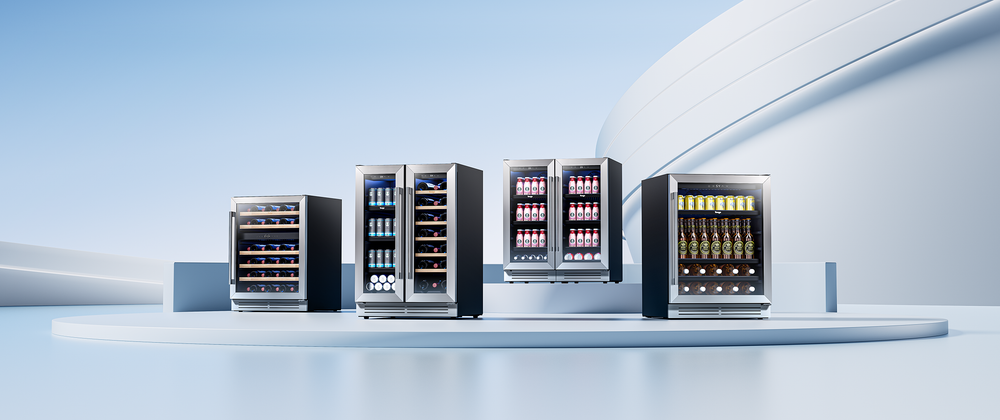
Compact, Narrow, or 24-Inch? Match the Fridge to the Room's Job
The practical difference between beverage cooler sizes isn't just how many cans they hold. Different formats make sense for different spaces and patterns of use.
| Beverage Fridge Type | Best-Fit Space | Typical Use Pattern | Restocking Pattern | Main Planning Priority |
|---|---|---|---|---|
| Compact Beverage Cooler | Apartment living room, small family room | Light to moderate use with a smaller selection of drinks | Frequent restocking is usually easy | Keep the appliance footprint small without adding more cold storage than the room needs |
| Narrow Beverage Fridge | Tight wall space, beside a console, or other space-constrained areas | Regular use where available width is a hard constraint | Depends on room usage and distance from the kitchen | Fit the available width while preserving door clearance and normal circulation |
| 24-Inch Beverage Fridge | Basement, larger family room, home theater, or game room | Frequent use, more drink types, and multiple users | Longer restocking cycles can be more practical | Maintain enough working stock without turning the entertainment room into bulk storage |
Compact Beverage Cooler: Best for Low-Intensity Use Close to the Kitchen
If the entertainment area is near the kitchen, only a few people usually use it, and restocking is easy, a compact beverage cooler can add convenience without taking over the room.
This is especially relevant in an apartment living room or smaller family room where the space already has to accommodate a sofa, media console, side tables, and normal circulation.
Adding a large refrigerator for relatively modest demand can make the room feel crowded.
In this situation, the goal isn't to hold a week's worth of drinks. It's to keep a few frequently used beverages cold and close at hand.
The tradeoff is straightforward: smaller capacity means more frequent restocking and less room for multiple package types. A compact cooler makes the most sense for households that are comfortable keeping less stock nearby and restocking more often.
Narrow Beverage Fridge: Best When Width Is the Hard Constraint
A narrow beverage fridge is more appropriate when the room already has a specific leftover space, such as a strip of wall beside a console, an opening next to basement cabinetry, or a rental where furniture and built-ins can't easily be rearranged.
These buyers approach the category differently.
The appliance first has to fit the available space without forcing the rest of the room to change. Capacity and other features come after that.
That makes actual width, depth, door configuration, and shelf layout especially important. “Narrow” shouldn't be treated as a shortcut for “works anywhere.” A refrigerator can be slim and still project too far into the room or create a problem when the door swings into a walkway.
The right narrow beverage fridge solves the space constraint without creating a new circulation problem.
24-Inch Beverage Fridge: Best for Higher Use and Longer Restocking Cycles
A basement entertainment room, larger family room, or heavily used game room usually has a different challenge.
The question is no longer whether there are any drinks nearby. It's whether the room can support longer periods of use without constant trips elsewhere in the house.
These spaces may regularly need water, soda, sparkling water, juice, and other beverages at the same time. In that context, the larger working capacity of a 24-inch beverage fridge can reduce restocking frequency and make multiple beverage categories easier to manage.
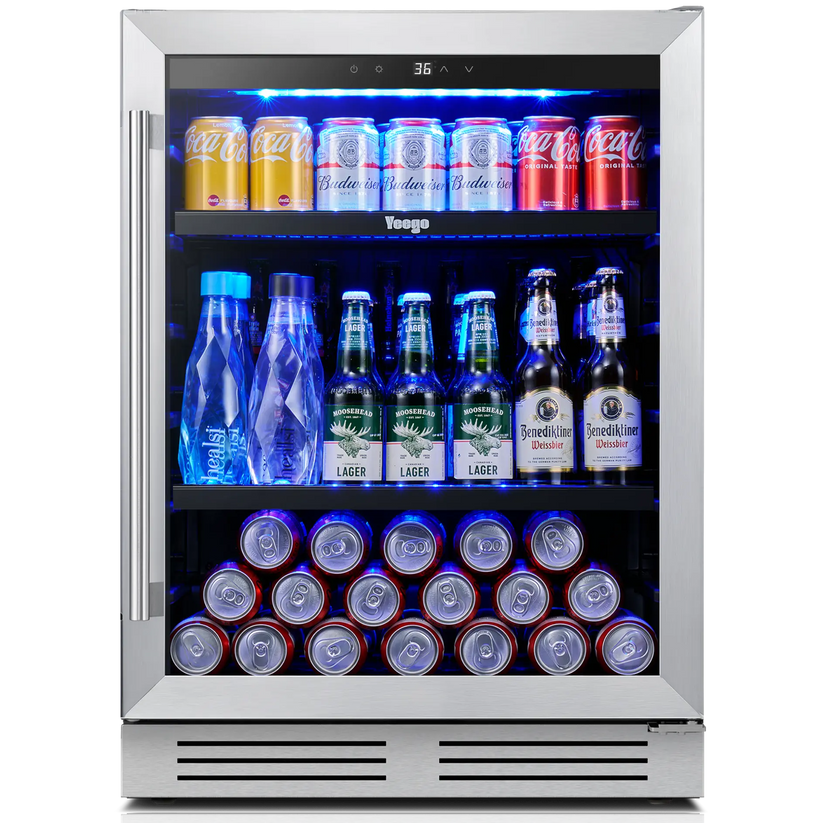
Yeego 24" Beverage Cooler
The real benefit of added capacity isn't simply “more cans.” It's fewer interruptions and fewer restocking trips.
That still doesn't mean every household should size up. If only two people occasionally watch movies in the room, a large fridge may simply hold drinks that sit unused for long periods. More cold storage doesn't create more convenience when the demand isn't there.
The fridge should match the job of the room, not the other way around.

A Beverage Station Only Works Long Term If Restocking Works Too
Most beverage station planning focuses on the person sitting on the sofa: how can that person get a drink more easily?
There's another equally important question to consider.
How do the drinks get into the fridge in the first place?
Every bottle and can eventually comes from grocery bags, the pantry, garage storage, or the main kitchen. If the beverage station is easy to use but frustrating to refill, the system has only solved half the problem.
A more practical approach is to divide household drink inventory into working stock and reserve stock.
Working stock is what stays in the entertainment area and covers normal use between restocks. Reserve stock stays in the pantry, garage, or another location better suited for bulk storage.
If a household buys a 24-pack of sparkling water, for example, there's no reason all 24 cans have to go into the movie-night fridge at once. The beverage fridge can hold the amount likely to be consumed over the next few days, while the rest stays in reserve.
That preserves room for different beverage categories and prevents the entertainment area from turning into bulk storage.
Restocking distance should also influence appliance capacity.
If the living room is only a few steps from the kitchen, refilling the beverage cooler every couple of days takes little effort. Giving up a large amount of living-room space just to avoid a few restocks may not make sense.
If the beverage fridge is downstairs and restocking means carrying multiple bottles down a flight of stairs, a larger working supply becomes more valuable.
Seen this way, “large capacity” is really about extending the time between restocks, not filling every shelf simply because there's room.
That's a more realistic way to compare 100-can, 150-can, or 180-can capacities than looking at the advertised number alone.
Three Movie Nights Can Require Three Completely Different Drink Stations
“Family movie night” sounds like a single use case, but housing type, room location, household habits, and frequency of use can lead to very different solutions.
Apartment Living Room: Protect the Room From Overbuilding
Consider an apartment where the kitchen opens directly into the living room and the space is usually used by two or three people.
Going back to the kitchen is already easy. The real opportunity is to reduce unnecessary interruptions without crowding a limited living area.
A compact or narrow beverage cooler combined with a small section of an existing console may be enough. The kitchen remains the primary storage system, while the living room keeps only the drinks that are currently in rotation.
Adding large cabinetry or a full beverage center may solve a problem the household never really had.
Basement Family Room: Increase the Room's Independent Use Time
A basement works differently.
The TV, sofa, and game consoles may all be downstairs, while the kitchen and main pantry are one floor above. Here, avoiding even a few refill trips has more practical value.
A basement beverage fridge can reasonably carry a larger working supply and more beverage categories. A small serving surface next to the appliance also becomes more useful because people may grab several drinks at once instead of one can at a time.
That still doesn't mean the basement needs a complete second kitchen. For many households, cold storage, simple serving space, and limited non-refrigerated storage cover most movie- and sports-night needs.
Dedicated Home Theater or Game Room: Fit the Drink Station Around the Room
A dedicated home theater or game room already has a stronger physical structure. Seating, screens, speakers, and circulation routes are usually established before beverage storage is added.
The drink station should work around those elements rather than becoming the new center of attention.
A fridge positioned on a side wall, near the entrance, or at the rear of the room often makes more sense than one placed directly beside the seats simply because it's closer.
These rooms may also see heavier overall use. Movies, gaming, sports, and tabletop games can all happen in the same space, so additional beverage capacity and clearer category organization may provide more value than minimizing appliance size at all costs.
There's no single best beverage station for all three households.
The common principle is that the home beverage station should follow the room's job instead of forcing every room into the same template.
What Most Entertainment Rooms Are Missing Isn't More Equipment
When people improve a family entertainment room, the instinct is often to keep adding: a larger TV, better speakers, a bigger sofa, more storage, maybe even a full home bar.
But the usefulness of a room is rarely determined by the number of things inside it. It depends more on whether everyday actions can happen without getting in each other's way.
A movie-night beverage station works the same way.
The most practical version doesn't move the entire kitchen next to the sofa. It keeps frequently used cold drinks in a clear, convenient place, avoids blocking major circulation paths, matches appliance capacity to real household demand, provides a small amount of serving space, and leaves bulk storage and more involved food prep where they already belong.
The result is an entertainment room that can work independently for longer without becoming another kitchen that has to be stocked, organized, and maintained.
That's also where a well-chosen cooling solution earns its place. A properly sized freestanding beverage cooler, narrow beverage fridge, or 24-inch beverage fridge can fill a functional gap in an otherwise finished living room, family room, or basement without asking the household to redesign the entire space around it.
Movie night doesn't need more equipment for the sake of having more equipment.
It needs a room that keeps working after everyone has sat down.
Frequently Asked Questions
1. Do beverage fridges have to be built into cabinetry?
No. Some models are designed for built-in installation, while others are intended for freestanding use, and some support both. Always check the installation requirements for the specific model rather than assuming based on its dimensions.
2. Is advertised can capacity the same as real usable capacity?
Not necessarily. Published capacity is usually based on a particular package size and loading arrangement. Bottles, slim cans, mixed drink formats, and different shelf positions can all change how much usable space remains.
3. What should you keep in a family-room beverage fridge?
Keep the drinks people regularly reach for while using the room instead of trying to move the household's entire beverage inventory there. Water, sparkling water, juice, soda, and other frequently used chilled beverages usually make the most sense.
4. Do you need adjustable shelves in a beverage fridge?
Adjustable shelving is useful when a household regularly stores different package heights and formats. It lets the interior adapt to real beverage habits rather than forcing every shelf to accommodate the same type of can or bottle.