
How Many Drinks Do You Really Need for Labor Day Weekend?
Key Takeaways
- Plan Labor Day drinks around peak demand, not just the total number of guests or the total weekend inventory.
- The number of drinks you buy is not the same as the number that needs to stay cold at once. Use staged chilling and replenishment to reduce refrigerator crowding.
- Real-world beverage fridge capacity depends on your mix of standard cans, slim cans, bottles, and shelf spacing, not advertised can count alone.
- Keep the main refrigerator focused on foods that require continuous refrigeration instead of letting party drinks take over valuable space.
- Choose beverage fridge capacity around your everyday drink inventory plus a reasonable entertaining buffer, rather than the largest party you host all year.
- If drinks regularly compete with food for refrigerator space beyond Labor Day, a dedicated beverage fridge may solve an ongoing household storage problem, not just a holiday one.
Labor Day weekend makes it surprisingly easy to overbuy. One trip to Costco, Sam’s Club, or the grocery store can quickly turn into cases of sparkling water, soda, bottled water, juice, and other drinks. Then everything comes home to a refrigerator that’s already holding burgers, produce, condiments, breakfast food, prepared dishes, and leftovers.
That’s where the real planning problem begins.
The more useful question isn’t simply “How many drinks should I buy?” It’s:
How many drinks will people actually go through over the weekend, and how many need to be cold at the same time?
Those are often two very different numbers.

You might buy several cases for the whole weekend, but only the drinks people are likely to reach for over the next few hours need refrigerator space. The rest can stay in appropriate backup storage until it’s time to chill them.
That distinction matters because practical Labor Day drink planning isn’t about cramming as much as possible into the fridge. It’s about keeping enough cold, knowing when to refill, and leaving room for everything else.
Start With the Kind of Labor Day Weekend You’re Actually Hosting
Guest count matters, but it doesn’t tell the whole story.
Eight people coming over for a two-hour dinner creates a very different storage challenge than eight people staying from Friday through Monday. One creates a short burst of demand. The other spreads drink consumption across several days.
Before deciding how much to chill, consider three things together: how many people will be there, how long they’ll stay, and whether everyone is likely to reach for drinks during the same few hours.
If it’s your family of four with two or three friends stopping by, adding a little extra to your usual drink supply may be enough. A 10-person Saturday afternoon gathering is different because more people may be grabbing drinks at the same time.
That’s why your busiest few hours can matter more than total weekend consumption when planning fridge space.
An open-house-style gathering works differently too. If guests come and go throughout the afternoon and evening, you may not need as many drinks cold at once. You just need an easy way to keep refilling them without overcrowding the fridge.
A Drink Count Alone Doesn’t Tell You How Much Fridge Space You Need
Once you know the size of the gathering, the next question is what you’re actually serving.
Beverage fridge capacity is often described in cans, but most people don’t store just one package size. A Labor Day drink mix might include standard soda cans, slim cans, bottled water, juice, glass bottles, and other containers. You may also be making room for beer or wine.
All of those packages use refrigerator space differently.
| Beverage Type | Typical Packaging | Impact on Refrigerator Space | Practical Storage Note |
|---|---|---|---|
| Soda | Standard cans | Low | Easy to arrange densely |
| Sparkling water | Standard or slim cans | Low to medium | Mixed can sizes can create unused gaps |
| Bottled water | Plastic bottles | Medium | Height may require shelf adjustment |
| Beer | Cans or glass bottles | Medium | Bottles generally use more room |
| Wine | 750 ml bottles | High | Bottle shape affects usable capacity |
| Sparkling wine | Wider bottles | High | Requires more horizontal and vertical room |
That’s why advertised can capacity is best treated as a reference point rather than a prediction of how many mixed drinks will fit.
A fridge rated for a certain number of standard cans may hold fewer individual drinks once you start mixing different bottle heights, widths, and shelf positions.
So instead of asking only, “How many drinks fit?” ask:
“How much of my usual drink mix fits while keeping everything easy to see and reach?”

Don’t Rely on One Fixed “Drinks Per Person” Formula
Party calculators that multiply guest count by a fixed number of drinks can be useful as a starting point, but they’re too broad to tell you how much refrigerator space you’ll actually need.
A short afternoon gathering and an event that stretches from lunch through dinner shouldn’t use the same estimate. Weather, meal timing, the number of children and non-drinking guests, what you already have at home, and how easily you can restock can all affect the total.
A more useful planning model is:
Your normal supply + guest demand + a reasonable buffer
Your normal supply is what you’d typically go through over the weekend even if no one were visiting. Bottled water, sparkling water, soda, juice, and other everyday drinks shouldn’t suddenly be counted twice just because it’s a holiday.
Guest demand is the extra amount you’re adding for the gathering. Base it on how long people will stay and what you plan to serve, not just the number of guests.
Then add a reasonable buffer for the unexpected. The goal is to give yourself some flexibility, not double every category.
Overbuying can actually make the weekend harder to manage. More drinks mean more fridge crowding, more shelf rearranging, less room for food, and more leftovers once the holiday is over.
Not Everything You Buy Needs to Go Into the Fridge at Once
Say you buy enough drinks for the entire long weekend. That doesn’t mean the whole supply needs to be chilled before the first guest arrives.
A more practical setup divides your drinks into three groups.
Ready-to-drink cold inventory is what people are most likely to reach for over the next several hours. Give those drinks the easiest-to-reach refrigerator space.
Cold refill inventory is the next round waiting to replace what gets used. It can stay in a less prominent refrigerated spot until you need it.
Room-temperature backup inventory includes unopened, shelf-stable drinks that can safely stay in appropriate non-refrigerated storage until it’s time to chill them.
The idea is simple:
Don’t try to chill everything at once. Keep drinks rotating.
For a long weekend, focus on the next busy stretch rather than the entire weekend. If Saturday afternoon is shaping up to be the busiest time, start Friday by chilling enough for that period.
As the weekend continues, restock based on what people are actually reaching for instead of automatically filling every empty space.
That approach makes much better use of your available fridge space.
Why the Main Fridge Usually Runs Out of Space First
The main refrigerator already has a bigger job during Labor Day weekend.
It may need to hold grilling ingredients, fresh produce, dairy, condiments, breakfast foods, prepared dishes, and leftovers. Many of those foods need continuous refrigeration and can’t simply be moved somewhere else to make room.
Drinks are different. They’re often stored in larger quantities and reached for repeatedly throughout the day. More importantly, much of your backup drink supply doesn’t need to be cold all at once.
That creates a natural competition between food storage and drink storage.
You can usually see the problem before the refrigerator is technically full. Drinks start taking over entire shelves. Bottles and cans have to be moved to reach ingredients. Guests keep heading back to the kitchen for another drink. Shelves get reorganized every time people come over.

Both the USDA and FDA advise against overfilling or overpacking a refrigerator because cold air needs room to circulate around refrigerated food.
At that point, usable space matters more than squeezing one more case onto a shelf.
If this happens only during one unusually large gathering each year, staged chilling or temporary overflow storage may be enough. But if the same problem comes up during ordinary weekends, movie nights, game days, or family gatherings, creating a dedicated drink station may be more useful than reorganizing the main refrigerator every time people come over.
That can be a sign that food and drinks are regularly competing for the same space.
Calculate Your Cold-Drink Buffer, Not Just Maximum Capacity
When you start considering a beverage refrigerator, one common mistake is choosing a size based on the biggest gathering of the year.
Labor Day may temporarily increase cold-drink demand, but a permanent appliance shouldn’t be sized around one unusually busy weekend.
A more useful approach is:
Everyday beverage inventory + a reasonable entertaining buffer
Start with the drinks you normally keep cold. Then leave enough flexibility for weekends, guests, and seasonal increases in demand.
If you’re comparing appliance sizes, it helps to choose the right beverage fridge size based on your normal inventory, available space, and restocking habits rather than one holiday weekend.
Occasional overflow can usually be handled with staged chilling or appropriate temporary storage instead of permanently reserving fridge space for a once-a-year peak.
Your package mix matters too.
A fridge that holds plenty of standard cans may feel much smaller once you add bottled water, slim cans, glass bottles, and other packaging. Adjustable shelves can help, but changing one shelf can also affect how the rest of the interior is used.
That’s why capacity is more useful when you compare it with your normal mix of drinks, not just the largest number printed in a specification.
Ask yourself:
Can this refrigerator hold the drinks we normally keep cold while still leaving some room for weekend extras?
That’s a much more practical benchmark than simply chasing the highest can count.
For households that regularly need more dedicated cold-drink space, a beverage refrigerator with flexible shelving can make it easier to manage both everyday inventory and weekend overflow.
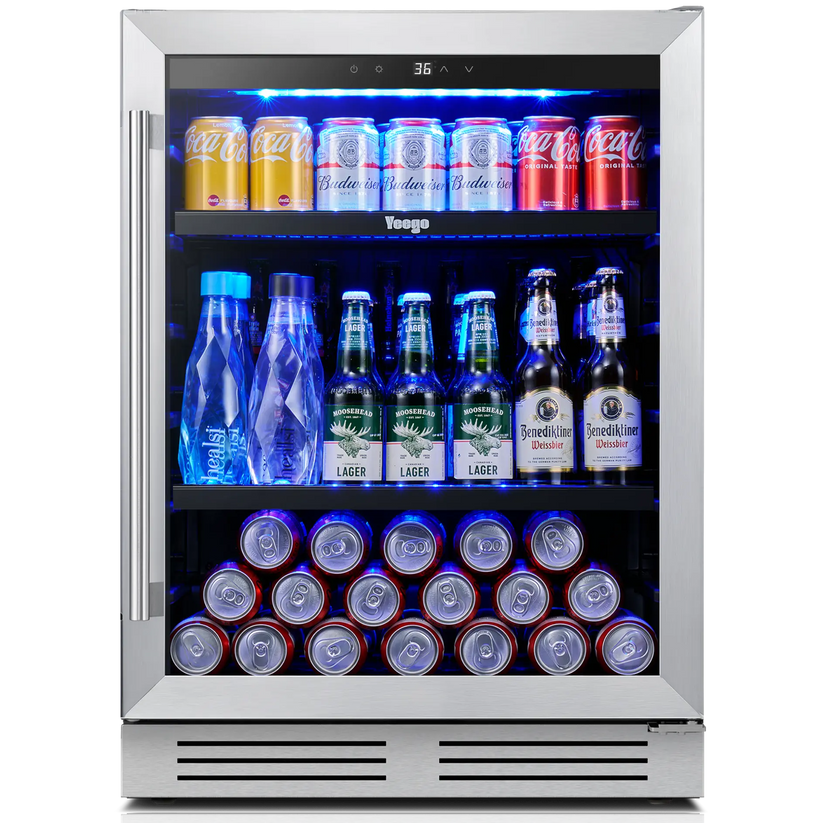
Yeego 24" Beverage Cooler
Three Labor Day Gatherings, Three Different Strategies
A Small Gathering With a Few Guests
If it’s just three or four of you hosting a few friends for dinner, you probably don’t need a major increase in permanent cold storage.
The better approach is to keep your usual drinks, add a reasonable amount for guests, and make sure the most popular options are already cold before people arrive.
Here, organization will probably matter more than maximum capacity.
An 8–12 Person Afternoon Gathering
A larger afternoon gathering creates a much busier serving window.
Water, sparkling water, soda, and other drinks may disappear quickly over just a few hours. Keeping more ready-to-drink options cold makes sense, with extra stock available for refills.
The priority here is easy serving.
Keep popular drinks visible and easy to grab. Guests shouldn’t have to dig through the fridge, and you shouldn’t have to rearrange shelves every time one option runs low.
Guests Coming and Going All Weekend
If you’ve got visitors arriving from Friday through Monday, you may need more drinks overall, but not necessarily more drinks cold at the same time.
Because demand is spread across several days, rotation becomes more useful. As one group of drinks is consumed, another can move into the fridge.
Here, rotation may matter more than maximum capacity.
The same idea applies when planning a home beverage station for everyday use. A useful setup should support your normal drink mix, restocking habits, and busiest serving times without requiring every backup drink to stay cold.
Two families can buy roughly the same amount for Labor Day and still need very different refrigerator setups. One may need more cold drinks ready for a short, busy gathering. Another may do better with a smaller supply that gets replenished throughout the weekend.
Will You Still Use the Beverage Fridge After Labor Day?
If you’re considering a dedicated beverage fridge, this question matters more than whether it can handle one holiday weekend.
First, think about a normal week. If sparkling water, soda, bottled water, or other drinks already force you to reorganize the main refrigerator, Labor Day is probably just making an existing storage problem more noticeable.
Next, think about where people actually drink them. If everyone gathers in a basement, garage, living room, media room, or another hangout space, keeping every cold drink in the kitchen can mean repeated trips back and forth.
Finally, consider whether your beverage supply changes only for summer or stays fairly consistent throughout the year. If you regularly keep a variety of drinks cold, dedicated beverage storage can serve an everyday purpose rather than a holiday-only one.
That becomes especially noticeable after Labor Day, when football season and more indoor game-day gatherings begin. The same need for easy access, organized storage, and quick refills can continue well into fall.
In that case, Labor Day doesn’t create the need for more beverage space. It simply makes that need easier to notice.

A More Practical Way to Plan Labor Day Drinks
Before you shop, start with the drinks already in the house. Then think about how many people will actually be there at the same time, how long the busiest part of the gathering will last, and which drinks people are most likely to reach for.
Separate what you normally need from the extra drinks you’re buying for guests. Add enough backup to give yourself some flexibility, but don’t put the entire weekend supply into the refrigerator at once.
As drinks disappear, refill based on what people are actually choosing.
The whole approach can be summed up in one line:
Buy for the weekend. Chill for the next few hours. Refill based on actual demand.
You’ll have enough drinks for the long weekend without asking your refrigerator to store every case cold from Friday through Monday.
The Better Question Isn’t “How Much Can My Fridge Hold?”
Good Labor Day drink planning isn’t about filling every inch of refrigerator space.
The goal is to keep food storage functional, make popular drinks easy to reach, keep enough backup on hand for refills, and avoid ending the weekend with a refrigerator still packed with drinks that don’t need to stay cold.
For one unusually large gathering, temporary overflow doesn’t necessarily justify buying another appliance.
But if drinks regularly compete with food for refrigerator space or send everyone back and forth to the kitchen, Labor Day may simply be exposing a problem that already exists.
In that case, comparing beverage refrigerators by size, shelf configuration, installation type, and usable capacity can help narrow the options around everyday needs rather than holiday demand alone.
The right beverage fridge capacity usually isn’t “as large as possible.”
It’s enough space for your normal beverage inventory, plus some breathing room for weekends, guests, and game days.
Frequently Asked Questions
1. How far in advance should I buy drinks for Labor Day weekend?
You can buy unopened, shelf-stable drinks several days ahead if you have suitable storage space. There’s usually no reason to refrigerate the whole weekend supply at once. Check what you already have first, then chill drinks ahead of your next busy period so refrigerator space stays available for food and other items that need continuous refrigeration.
2. How many different types of drinks should you serve at a Labor Day party?
More variety isn’t always better. Start with water and a few broadly appealing non-alcoholic options, then add other drinks based on the people you’re actually hosting. Too many overlapping choices can leave you with more leftovers and less refrigerator space without adding much to the gathering.
3. Is can capacity accurate when choosing a beverage fridge?
Can capacity is useful for comparing models, but it’s best treated as a reference rather than a guarantee of exactly how many of your drinks will fit. Real homes often mix standard cans, slim cans, bottled water, and glass bottles, and shelf positioning can change the amount of usable space.
4. Is a built-in or freestanding beverage fridge better for entertaining?
Neither option is automatically better. Built-in models can work well in planned cabinetry, undercounter setups, or permanent home bars when installed according to the model’s ventilation and clearance requirements. Freestanding models may offer more placement flexibility. Your available space, ventilation requirements, door clearance, and how you use the room should guide the decision.
5. How do you reset a beverage fridge after a party weekend?
Start by taking inventory. Remove drinks that no longer need priority cold space, clean up spills, and adjust the shelves around the cans and bottles you normally keep on hand. The goal is to return the fridge to its everyday role instead of keeping a holiday-level supply cold indefinitely.