
Beverage Fridge vs. Cooler vs. Ice Tub for Labor Day
Key Takeaways
- For gatherings at home, use a beverage fridge as the main cold-storage and restocking point.
- Use a portable cooler to move prechilled drinks closer to a patio, garage, driveway, or tailgate area.
- Use an ice tub as a small, high-turnover serving station rather than your all-day storage solution.
- Whenever possible, prechill large batches instead of relying on a beverage fridge or cooler to handle a large load of room-temperature drinks right before guests arrive.
- When the gathering spreads across several areas, a layered drink setup usually works better than keeping every drink in one place.
When drinks start warming up halfway through a Labor Day gathering, the problem usually isn’t that you bought too little. More often, the drinks are simply in the wrong place at the wrong time.
At the start of the party, the ice tub may be full of beer and soda, with another case packed into a portable cooler. A few hours later, the ice is melting, cans are sitting in water, newly purchased drinks are still warm, and guests keep heading back to the kitchen for something cold.
You have all three cooling options, but they’re not working together.
A beverage fridge, portable cooler, and ice tub each have a different job. The beverage fridge keeps the main supply cold. The cooler moves and stages drinks closer to the gathering. The ice tub gives guests easy self-serve access.
Keeping Labor Day drinks cold all afternoon isn’t about picking one of the three. It’s about giving each one a specific job.

Start With Three Different Jobs: Cooling, Cold Holding, and Serving
Party drink planning often treats “getting drinks cold” and “keeping drinks cold” as the same job. They’re not. Add guest access to the mix, and a good setup needs to handle three different stages.
Cooling: Removing Heat From the Drinks
When room-temperature drinks go into a beverage fridge, the appliance has to cool the new load while recovering from the warmer air that enters during loading.
The more drinks you add at once, and the warmer they are, the more work the fridge has to do.
Frequent door openings can also slow things down. Each opening lets warmer room air into the cabinet, while overcrowded shelves can make it harder for cold air to move around the drinks.
A beverage fridge provides active cooling, but it isn’t an instant chiller. It works best when you build your cold inventory ahead of time and use the fridge to keep that supply ready throughout the gathering.
Cooling time will vary by model, starting temperature, container size, room conditions, shelf arrangement, and how often the door is opened.
Cold Holding: Keeping Chilled Drinks Cold
A portable cooler works differently. Instead of actively refrigerating the drinks, insulation and ice or cold packs help slow down warming.
Starting with prechilled cans and bottles gives the cooler an easier job. If you fill it with room-temperature drinks, more of the ice has to go toward cooling those drinks first, so you may need to replenish it sooner.
That’s why two similar coolers can perform very differently during the same afternoon. Starting drink temperature, direct sunlight, outdoor temperature, how often the lid is opened, and how the cooler is packed all make a difference.
Serving: Putting Cold Drinks Where Guests Need Them
Keeping drinks cold is only part of the plan. Where you put them can make the gathering feel easier or create extra traffic through the house.
Keep every drink in the kitchen, and guests end up cutting through the cooking area over and over. Move the entire supply outside too early, though, and your backup drinks spend more time away from refrigeration than they need to.
A more practical approach is to keep most of the supply at a central cold-storage point and move smaller batches closer to the gathering.
If party drinks regularly crowd the kitchen, setting up a separate summer drink station can also keep popular options closer to guests without moving everything at once.
The guest-facing station doesn’t need to hold every drink you bought for the weekend. It just needs enough variety for the moment and an easy way to restock.
Beverage Fridge vs. Portable Cooler vs. Ice Tub
In this article, “ice tub” means an open container that holds several cans or bottles at once. It may also be called a drink tub or party tub. It’s different from the smaller ice bucket typically used for a single bottle of wine.
| Consideration | Beverage Fridge | Portable Cooler | Ice Tub or Party Tub |
|---|---|---|---|
| Primary role | Ongoing refrigeration and inventory management | Mobile overflow storage and temporary cold holding | Visible, high-access serving |
| How it works | Actively removes heat | Uses insulation and ice to limit warming | Uses ice or ice water in direct contact with containers |
| Temperature stability | Relatively stable under appropriate conditions | Changes with ice level, outdoor temperature, and lid openings | More exposed to ambient heat and melting ice |
| Portability | Low | High | Moderate |
| Best locations | Kitchen, home bar, living area, or basement | Patio, garage, driveway, or tailgate | Serving table, bar, or main gathering area |
| Best use period | Ongoing and long-term | Short to medium term | Short-term, high-turnover service |
| Main limitation | Requires power, ventilation, and an appropriate operating environment | Requires ice, drainage, and cleaning | Limited capacity and increasing water management as ice melts |
The real question isn’t which option wins overall. It’s which stage of the drink flow each one should handle.
A beverage fridge provides stability, a cooler provides mobility, and an ice tub provides immediate access.
The Beverage Fridge: The Home Base of the Drink System
For a gathering that lasts several hours, the beverage fridge works best as the home base for cold storage and restocking.
Its biggest advantage is keeping an organized supply ready before and during the event, rather than trying to chill every last-minute purchase after guests arrive.
Beer, seltzer, soda, bottled water, and other drinks for later rounds can stay chilled until they’re needed. That keeps party beverages from taking over the main refrigerator, where food may already be competing for space.
It also makes it easier to see what’s left and decide what needs to come out next.
You don’t have to organize the fridge strictly by beverage type. For Labor Day entertaining, it makes more sense to think about both container shape and expected demand.
Keep popular drinks easy to see and reach. Give heavier glass bottles stable shelf support, and adjust shelf spacing for the mix you actually keep, whether that includes slim cans, standard cans, plastic bottles, or taller glass bottles.
Advertised capacity is a useful reference, but real-world storage changes once you start mixing different package sizes.
That’s why choosing the right beverage fridge size should start with your everyday inventory, package mix, available space, and restocking habits rather than the highest can count listed on the product page.
There’s also no need to fill every gap. Leave enough room for practical airflow, easy access, and a later batch when needed.
A fridge packed so tightly that you can’t easily find or remove a drink may be less useful during a gathering than one that’s slightly less full but better organized.
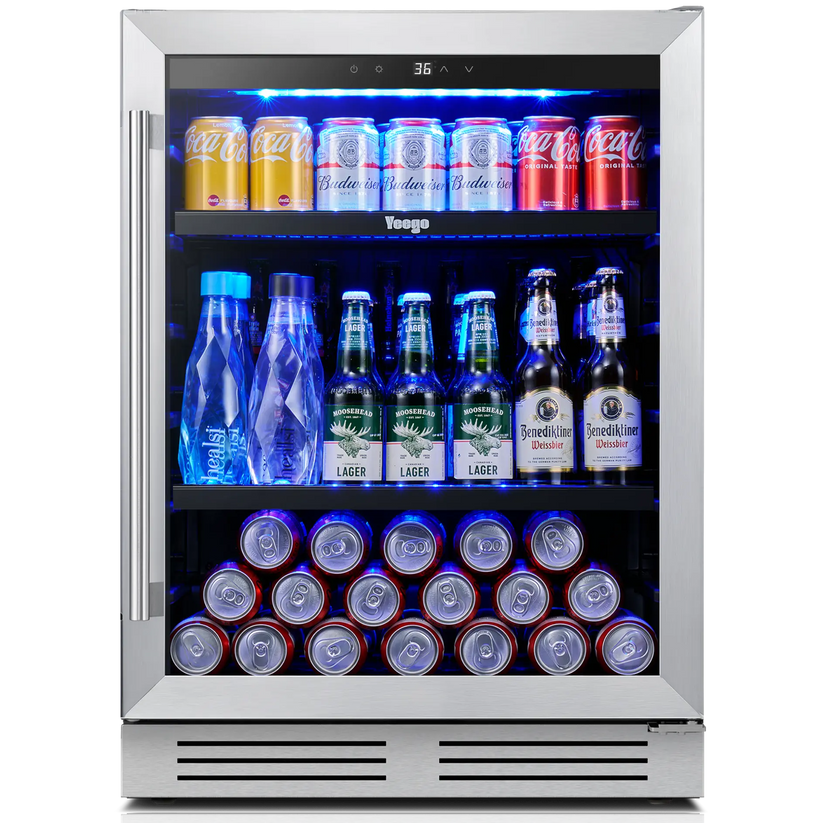
Yeego 24" Beverage Cooler
Placement matters too.
The installation and ventilation requirements for built-in and freestanding beverage fridges aren’t automatically interchangeable.
An indoor model shouldn’t be moved to an uncovered patio simply because it fits beside the serving table.
Before using a beverage fridge in a garage, basement, or semi-outdoor space, check the specific model’s requirements for installation, ambient temperature, ventilation, moisture exposure, and electrical use.

The Portable Cooler: A Mobile Buffer Between the House and the Party
A portable cooler becomes especially useful when the gathering moves beyond the kitchen to a patio, garage, driveway, or yard.
It lets you bring cold drinks closer to guests without moving the entire supply out of the beverage fridge.
Whenever possible, start with drinks that are already cold. Prechilled cans and bottles allow the cooler and ice to focus on keeping them cold.
Add a large batch of room-temperature drinks, and more of that ice has to go toward cooling the new load first.
How you organize the cooler matters too.
When every drink is mixed together, guests may leave the lid open while they search.
Grouping drinks into a few broad sections, or keeping popular options near the top, makes things easier to find and can help reduce unnecessary lid openings.
For larger gatherings, it can also help to keep drinks separate from perishable food.
FoodSafety.gov recommends keeping drinks in a separate cooler because beverage coolers tend to be opened more frequently. That allows the food cooler to stay closed longer and makes both easier to manage.
A cooler still has limits. Conditions change as the ice melts, temperatures rise, and the lid keeps opening throughout the day.
There’s also more cleanup afterward, including draining meltwater, cleaning the interior, and letting the cooler dry completely.
That makes a portable cooler useful for the day, but not a replacement for everyday refrigerated drink storage.

The Ice Tub: A High-Turnover Station Within Easy Reach
The biggest advantage of an ice tub isn’t capacity. It’s easy access.
Guests can see what’s available without opening a door, searching through shelves, or asking where the drinks are.
At a relaxed Labor Day gathering, an ice tub near a table, bar, or seating area can be much more convenient than sending everyone back to the kitchen.
It works well for canned beer, seltzer, soda, bottled water, and other drinks likely to be picked up soon.
Ice and meltwater surround the containers and help keep them cold, although the open design also leaves the tub more exposed to warm outdoor air.
That’s why an ice tub works best with small batches and fast turnover. Think of it as a serving station, not the place to store the entire afternoon’s supply.
Filling it with every available drink can quickly create extra work. The tub gets heavy, meltwater builds up, paper labels can deteriorate, and leftover cans and bottles need to be dried and reorganized later.
Instead, start with a focused selection and refill it based on what guests are actually choosing.
Placement matters here too. Keep the tub close enough to be convenient without blocking a walkway.
Set it on a stable, water-resistant surface, and make sure water and other nonalcoholic options stay easy to see rather than disappearing underneath layers of beer and ice.

Build a Three-Level Labor Day Drink System
If the gathering stretches across the kitchen, living room, patio, or garage, it can help to divide the drink setup into three simple levels.
Level One: Core Cold Storage
The beverage fridge holds the main supply until it’s needed.
It doesn’t have to sit in the busiest part of the gathering, but it should be somewhere that makes restocking easy.
This is where you can quickly see what’s left, check the mix, and decide what should go out next.
The goal here is reliable storage, not making the entire drink supply visible at once.
Level Two: Mobile Buffer Storage
The portable cooler sits between the main supply and the guest-facing station.
Depending on the gathering, that might mean near the patio door, in the garage, or in a shaded outdoor spot.
Load it with prechilled drinks you’re likely to need next. This keeps the next round close without moving the full reserve outside.
It’s especially useful when the beverage fridge is in the kitchen but most of the gathering is happening elsewhere.
Level Three: Guest-Facing Service
The ice tub is the station guests use directly. Keep the selection focused and easy to read.
Then restock according to what people are actually drinking.
If seltzer is disappearing faster than beer, bring out more seltzer. If bottled water becomes more popular later in the afternoon, move it where guests can see it easily.
The full flow looks like this:
Prechill in the beverage fridge → stage in the portable cooler → serve from the ice tub → restock based on demand.
This setup doesn’t just help drinks stay cold. It can also keep the main refrigerator available for food, reduce extra carrying, and cut down on traffic through the kitchen.
Match the Setup to Your Gathering
You don’t need all three options for every occasion.
The right combination depends on how long the gathering lasts, where people will spend their time, how far drinks need to move, and what you’re serving.
| Gathering Type | Recommended Setup | Main Planning Priority |
|---|---|---|
| Small indoor gathering | Beverage fridge, with an optional small ice tub | Keep drinks near the living or dining area without creating unnecessary serving stations |
| Indoor-outdoor gathering | Beverage fridge, portable cooler, and small ice tub | Use the fridge for core inventory and the cooler for patio restocking |
| Garage or basement game day | Nearby beverage fridge, with a cooler if needed | Reduce trips upstairs or through the main kitchen |
| All-day gathering | Beverage fridge, backup cooler, and guest-facing station | Restock in batches instead of placing the entire inventory outside |
| Tailgate or off-site gathering | Prechill at home and transport in a portable cooler | Use the beverage fridge for preparation and the cooler for transport and on-site holding |
| Family gathering with children | Organized beverage fridge and a separate nonalcoholic station | Keep water, juice, soda, and other nonalcoholic choices clearly visible and easy to reach |
A small indoor gathering may need only a beverage fridge and a compact ice tub.
When the serving distance is short and the group is small, adding several storage points can make restocking and cleanup more complicated than necessary.
An indoor-outdoor gathering is where the full three-level setup becomes more useful.
The beverage fridge can keep the main supply inside, the cooler can stay near the transition to the patio, and the ice tub can sit close to the seating area.
Guests get easy access outside without leaving the entire drink supply exposed to outdoor conditions.
A tailgate or off-site gathering works differently.
Without a refrigerator at the destination, the beverage fridge at home becomes part of the preparation. Prechill the drinks first, then let the portable cooler handle transportation and cold holding.
For that setup, packing order, travel time, shade, and how often the lid is opened matter more than creating a large drink display.
Plan Around the Rhythm of the Day
The order in which drinks move through the setup can make just as much difference as the containers you use.
The Day Before: Build the Cold Inventory
Start by checking your drink mix and approximate quantities.
Make room in the beverage fridge, adjust the shelving for the containers you’ll be serving, and begin chilling the drinks you expect to use first.
Clean the portable cooler and ice tub, check for lingering odors, and let both dry completely before loading.
You can also buy or prepare the ice ahead of time, but there’s no need to fill the tub yet.
The goal isn’t to pack every available inch. Give the drinks enough time and space to chill properly.
If you pick up more room-temperature drinks at the last minute, don’t assume they’ll be ready just because they’re sitting next to cold cans. Give them extra time or chill them in smaller batches.
Before Guests Arrive: Set Up the First Round
Move the first batch of prechilled drinks into the portable cooler.
Add only the opening selection to the ice tub, focusing on the drinks people are most likely to choose first.
Keep water and other nonalcoholic options easy to identify rather than buried under beer or placed somewhere guests have to ask about.
Leave a useful reserve in the beverage fridge.
The serving area doesn’t need to look like a fully stocked store display. It just needs enough variety for the moment and an easy path for restocking.
During the Gathering: Restock Based on Demand
You don’t need a strict restocking schedule.
Pay attention to what people are actually drinking and refill popular options before they run out.
If one drink is moving slowly, there’s no need to keep bringing out more just to make the display look full.
Restocking in batches means fewer drinks sit outside refrigeration longer than necessary.
The beverage fridge holds the reserve, the cooler keeps the next round nearby, and the ice tub handles what guests need right now.
After the Gathering: Reset for Everyday Use
Dry and sort unopened drinks before putting them away.
Drain the cooler and ice tub, clean them, and allow them to dry completely before storage.
Then reset the beverage fridge for everyday use.
Move your regular water, soda, seltzer, or other favorites back into convenient spots, consolidate leftovers, and leave some flexible space for the next game day or weekend gathering.
Which One Do You Actually Need?
If the main problem is that drinks regularly crowd the kitchen refrigerator, a dedicated beverage fridge gives you the strongest foundation.
It provides ongoing cooling, clearer organization, and a dedicated place for everyday drinks before and after the holiday.
If the challenge is moving drinks between the kitchen, patio, garage, driveway, or an off-site gathering, a portable cooler is the more useful tool. It handles distance and temporary overflow in a way a fixed appliance can’t.
If the priority is giving guests quick, self-serve access to a smaller selection, an ice tub is the simplest option.
Problems usually start when one tool is asked to do every job.
An ice tub gets harder to manage when it holds the entire day’s supply. A cooler may go through ice faster when it’s expected to chill a large load of warm drinks. And a beverage fridge may need more time to recover when it’s heavily loaded with room-temperature drinks right before guests arrive.
A well-planned Labor Day drink setup gives each option one clear job: the beverage fridge provides stability, the cooler provides mobility, and the ice tub provides immediate access.
Set it up that way, and cold drinks stop being something you have to keep managing. They simply stay ready as the afternoon unfolds.
Frequently Asked Questions
1. Can a beverage fridge quickly cool a large batch of room-temperature drinks?
It can cool them, but not necessarily as quickly as you need right before a gathering.
Cooling time depends on the number of drinks, their starting temperature, container size, shelf arrangement, room conditions, and the performance of the specific appliance.
Instead of adding an entire room-temperature case shortly before guests arrive, load drinks earlier when possible or add them in smaller batches.
Keep ready-to-serve drinks easy to identify so guests aren’t accidentally grabbing cans that are still cooling.
2. Should drinks and perishable food be packed in the same cooler?
They can share a cooler when space is limited, but separate coolers are usually easier to manage for a larger gathering.
Because the drink cooler tends to be opened more often, FoodSafety.gov recommends keeping beverages separate from perishable food when possible. That allows the food cooler to stay closed longer.
If everything has to share one cooler, keep food properly sealed, prevent raw ingredients from contacting ready-to-eat foods, and minimize how long the lid stays open.
3. Can beer, soda, seltzer, and bottled water share the same beverage fridge temperature?
For most casual serving setups, yes.
These packaged drinks can usually share one beverage fridge, although their preferred serving temperatures may differ.
Choose a setting that works for the drinks you store most often and stays within the appliance’s specified temperature range.
If you’re also storing wine or another beverage with a different temperature preference, a dual-zone model or separate storage area may give you more flexibility.
A beverage fridge intended for drinks should not be used as a substitute for proper perishable food storage unless the appliance is specifically designed and rated for that purpose.
4. How should leftover drinks be stored after the party?
Start by separating unopened shelf-stable drinks from beverages that should remain refrigerated.
Dry any cans or bottles that have been sitting in ice water before putting them back into a pantry, beverage fridge, or other storage area.
Then reset the beverage fridge for everyday use.
Bring your regular drinks back to the easiest-to-reach spots, rotate older inventory forward, and leave enough open space for normal restocking.
5. Can warm drinks be added to a beverage fridge during the party?
Yes. Just keep in mind that a large warm load gives the appliance more heat to remove and may temporarily affect how quickly the cabinet returns to its usual temperature.
When possible, add incoming drinks in smaller batches and keep them separate from drinks that are already ready to serve.
That way, guests don’t have to keep opening the door to check which cans are cold.